

Holographic Display Market Outlook 2026–2035, Driven by a 19.10% CAGR
Holographic Display Market
Holographic Display Market Size, Share and Research Report By Technology (Semi-Transparent or Electro Holographic Display, Touchable, Display, Laser, Piston)
Holographic Display Market: Holographic displays are revolutionizing immersive visualization by delivering realistic 3D images for healthcare, entertainment, education, and industrial applications.”
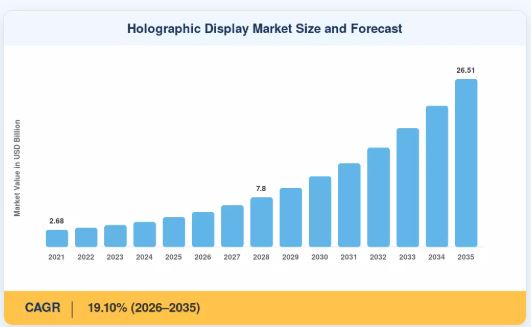
TOKYO, TOKYO, JAPAN, July 29, 2026 /EINPresswire.com/ -- The Global Holographic Display market reached an estimated USD 4.62 billion in 2025 and is projected to open the forecast window at roughly USD 5.50 billion in 2026, climbing to USD 26.51 billion by 2035 at a CAGR of 19.10%. Two forces anchor this trajectory: automotive OEMs embedding augmented-reality windshield systems in premium vehicle lines, and U.S. hospital networks investing over USD 900 million in volumetric surgical-planning suites between 2023 and 2025 both of which are pulling holographic displays out of the prototype lab and into recurring procurement budgets. — Market Research Future (MRFR)
The market's 19.10% CAGR reflects the convergence of automotive AR head-up display mandates (~3.1% CAGR impact), healthcare volumetric imaging adoption (~2.9%), luxury retail digital signage overhauls (~2.6%), and AI-driven content-creation cost reduction (~2.3%) accelerating across the world's leading display-manufacturing and premium-retail geographies simultaneously.
Legacy flat-panel signage and static projection systems are increasingly being replaced by electro-holographic engines capable of rendering full-parallax imagery in real time. Production-grade micro-LED waveguide yields crossed the 70% threshold in late 2024, pulling unit costs down roughly 18% year-on-year and unlocking deployment budgets that had been frozen during the prototype era.
Asia-Pacific dominates the market with an estimated 39.3% share, driven by dense display-component manufacturing clusters in China, Japan, and South Korea. The Middle East & Africa region is the fastest-expanding geography as luxury retail brands in the Gulf states digitize storefronts at scale. Not far behind is North America, with hospital-network procurement and defense simulation budgets sustaining demand. Holographic displays are becoming a mainstream spatial-computing infrastructure element rather than a novelty showcase as optics, compute, and content pipelines converge.
Get Full PDF Sample Copy of Report: (Including Full TOC, List of Tables & Figures, Chart) @
https://www.marketresearchfuture.com/sample_request/5118
➤ How Significant Is the Holographic Display Market's Growth?
The holographic display market's trajectory from USD 4.62 billion in 2025 to a projected USD 26.51 billion by 2035 represents nearly a six-fold expansion over the forecast decade, reflecting the structural shift from isolated prototype installations toward commercial-grade spatial-computing infrastructure deployed across automotive, healthcare, and retail environments. The market's 19.10% CAGR is anchored in a display-technology investment supercycle where premium automotive AR programs, reimbursable volumetric imaging suites, and AI-compressed content pipelines are all specifying holographic hardware as a differentiating, non-negotiable capability.
Hardware accounted for an estimated 80.2% of 2025 revenue, remaining the dominant cost center as optical engines, spatial-light modulators, and micro-LED arrays anchor every commercial deployment, while the services segment is forecast to grow at a 24.1% CAGR through 2035 as managed content-creation and maintenance contracts gain traction. Electro-holographic technology captured roughly 43.5% of 2025 revenue the largest single technology segment followed by touchable and mid-air haptic systems, which are projected to expand at a 22.0% CAGR as medical simulation and interactive exhibition use cases scale. Digital signage and kiosks represent an estimated 31.8% of the product mix, the largest single product category, while medical scanners and microscopes are advancing at a 26.5% CAGR as reimbursement-code approvals convert hospital procurement committees from skeptics to active buyers.
➤ What Does the Future Hold for the Holographic Display Market?
Automotive AR head-up display mandates contribute approximately 3.1 percentage points to the holographic display market's CAGR the single highest driver impact. German automakers are investing more than EUR 1.2 billion between 2023 and 2025 to install full-windshield augmented-reality overlays into top vehicle lines, and the Euro NCAP 2026 evaluation process grants additional safety credits to vehicles equipped with AR-based hazard-warning HUDs, generating a regulatory pull that Chinese EV manufacturers have begun to address. Tier-1 suppliers report order-book visibility through 2028, making automotive the single most significant near-term stimulus for the market.
Healthcare volumetric imaging adoption contributes approximately 2.9 percentage points to the CAGR, establishing hospital procurement as a primary, reimbursement-anchored demand source. In 2024, the U.S. Centers for Medicare and Medicaid Services authorized three new reimbursement codes covering operations that include volumetric holographic visualization, directly enhancing hospitals' return on investment in these systems. Tier-1 hospitals in Boston, Houston, and San Francisco have reported a 22% reduction in pre-operative planning time since implementing 3D holographic imaging suites, while luxury retail digital signage overhauls add a further 2.6% to the CAGR as Gulf-state brands replace static window displays with interactive volumetric presentations.
The next product generation is shifting from studio-dependent volumetric capture to AI-driven, real-time spatial-content generation, allowing brands and clinicians to produce holographic assets without specialized light-stage facilities. Vendors are increasingly competing on software ecosystem breadth cloud-managed content libraries, gaze-analytics dashboards, and remote display configuration rather than optical specifications alone. Manufacturers are standardizing on neural-radiance-field rendering pipelines that compress production timelines from weeks to hours, cutting creative costs by an estimated 40% and removing the content scarcity that had been the binding constraint on enterprise adoption of the holographic display market.
Get access to the full description of the report @
https://www.marketresearchfuture.com/reports/holographic-display-market-5118
➤ Who Are the Key Players in the Holographic Display Market?
The holographic display market is moderately fragmented, with the combined share of the top five estimated at 28–36% and no single vendor dominating outright a structure consistent with a market still defined by differentiated optical approaches (electro-holographic versus light-field versus laser-plasma) rather than commoditized hardware. MRFR identifies the following key participants with estimated revenue share ranges:
★Konica Minolta (~7–10% share)
★Looking Glass Factory (~5–8% share)
★Leia Inc. (~4–7% share)
★RealView Imaging (~4–6% share)
★Hypervsn (Kino-mo) (~3–6% share)
★Light Field Lab (~3–5% share)
★Sony Corporation (~3–5% share)
★Samsung Electronics (~2–5% share)
★Provision Interactive Technologies (~2–4% share)
★Holografika (~2–3% share)
Strategic competition in the holographic display market is increasingly defined by waveguide fabrication IP and access to qualified micro-LED supply with fewer than a dozen qualified fabrication lines globally cited as the top capacity constraint alongside spatial-content ecosystem depth, viewing-angle and resolution performance, and the breadth of display-as-a-service contracts that convert one-time hardware sales into recurring managed-content revenue.
➤ What Are the Emerging Trends in the Holographic Display Market?
Several transformational trends are redefining the holographic display market's evolution through 2035:
AI-Augmented Spatial Computing: Real-time neural-radiance-field rendering is expected to run on edge devices priced below USD 500 by 2028, democratizing content creation for the holographic display market and enabling retailers, educators, and clinicians to produce custom holographic assets without specialized studios.
Automotive AR Head-Up Display Scaling: Full-windshield augmented-reality overlays are moving from flagship premium vehicles to broader model lines as Euro NCAP safety-credit incentives and Chinese EV manufacturer adoption expand the addressable automotive installed base, with Zeiss and Hyundai Mobis targeting 7 million panoramic units by 2030.
Platform and Ecosystem Economics Displacing Hardware-Only Sales: Vendors are building recurring-revenue moats through cloud-managed content libraries, gaze-analytics dashboards, and display-as-a-service contracts that reduce upfront capital expenditure by 50–60% compared with outright purchase, with recurring-revenue streams projected to reach 30–35% of total market value by 2032.
Emerging-Market Retail and Smart-City Digitization as Greenfield Opportunity: Government-backed smart-city projects in Riyadh, Mumbai, and Jakarta increasingly specify holographic installations over conventional LED walls in digital-signage corridors, channeling public infrastructure budgets into display procurement and lowering the effective cost for private retailers.
Healthcare and Medical Education Volumetric Adoption: Holographic anatomy tables already deployed at 28 U.S. medical schools are enabling students to interact with full-body volumetric datasets in real time, with expansion into nursing, physiotherapy, and veterinary curricula expected to triple the addressable installed base by 2030.
Buy Full Research Report:
https://www.marketresearchfuture.com/checkout?currency=one_user-USD&report_id=5118
➤ How Is the Holographic Display Market Segmented?
The holographic display market report provides a comprehensive segmentation framework:
By Component: Hardware, Software, Services
By Technology: Semi-Transparent or Electro Holographic Display, Touchable, Display, Laser, Piston
By Product: Camera, Digital Signage, Kiosks, Medical Imaging or Scanners, Computed Tomography, Magnetic Resonance Imaging, Other
By Application: Consumer Applications, Commercial Applications, Industrial Applications, Others
By Region: Asia-Pacific (39.3%), North America (27.5%), Europe (20.8%), Middle East & Africa (22.9% CAGR), South America (5.5%)
➤ What Are the Regional Insights from the Holographic Display Market?
Asia-Pacific leads the holographic display market with a 39.3% share in 2025, with China commanding roughly 42% of regional revenue through vertically integrated micro-LED manufacturing and consumer electronics production. Japan contributes an 18.8% regional CAGR through display-component R&D and automotive applications, South Korea adds USD 0.28 billion through OLED and LED fabrication and entertainment deployments, and India is posting a 20.6% CAGR as retail digitization and smart-city programs earmark digital-signage corridors across 12 urban centers. ASEAN contributes USD 0.15 billion of regional revenue through retail and exhibition deployments.
North America holds approximately 27.5% of global holographic display market revenue in 2025, with the United States commanding roughly 78% of regional share through hospital volumetric-suite procurement and Department of Defense simulation budgets exceeding USD 600 million annually. Canada is growing at an 18.5% CAGR through university research grants establishing holographic-research centers in Toronto and Vancouver, and Mexico contributes USD 0.08 billion through automotive assembly-plant HUD integration for export vehicles.
Europe accounts for approximately 20.8% of global holographic display market share, with Germany commanding roughly 31% of regional revenue through premium automotive AR-HUD programs from BMW, Mercedes-Benz, and Volkswagen. The UK is growing at an 18.2% CAGR through retail and entertainment signage, France contributes USD 0.14 billion through aerospace simulation and luxury retail, Italy is posting a 17.4% CAGR through fashion and automotive design visualization, and the Nordic countries are growing at 17.8% through healthcare imaging and education applications.
The Middle East & Africa is the fastest-growing region in the holographic display market, posting a forecast CAGR of 22.9% through 2035. The UAE commands roughly 35% of regional revenue through luxury retail and tourism, with Dubai hosting the world's densest cluster of holographic retail installations per square kilometer. Saudi Arabia is growing at a 24.2% CAGR through NEOM and Vision 2030 smart-city programs representing over USD 500 million in committed display infrastructure spending through 2030. South America holds roughly 5.5% of global revenue, with Brazil commanding approximately 58% of regional share through event-driven deployments at trade fairs and experiential retail activations, and Argentina posting a 17.0% CAGR through retail pilot programs.
➤➤➤ Regional & Country-Level Reports by Market Research Future:
US Holographic Display Market -
https://www.marketresearchfuture.com/reports/us-holographic-display-market-14304
➤➤➤ Industry Analysis Reports by Market Research Future:
Microelectronics Cleaning Equipment Market
https://www.marketresearchfuture.com/reports/microelectronics-cleaning-equipment-market-40934
Mobile Soc Market
https://www.marketresearchfuture.com/reports/mobile-soc-market-40939
Motor Vehicle Sensor Market
https://www.marketresearchfuture.com/reports/motor-vehicle-sensor-market-40945
Multilayer Printed Circuit Board Market
https://www.marketresearchfuture.com/reports/multilayer-printed-circuit-board-market-40955
Green Laser Diode Market
https://www.marketresearchfuture.com/reports/green-laser-diode-market-41042
Machine Vision And Vision Guided Robotics Market
https://www.marketresearchfuture.com/reports/machine-vision-and-vision-guided-robotics-market-41116
Enterprise Dect Phones Market
https://www.marketresearchfuture.com/reports/enterprise-dect-phones-market-41164
Wiring Duct Market
https://www.marketresearchfuture.com/reports/wiring-duct-market-41251
Communication Analog Integrated Circuits Market
https://www.marketresearchfuture.com/reports/communication-analog-integrated-circuits-market-42108
Connected Street Lights Market
https://www.marketresearchfuture.com/reports/connected-street-lights-market-42121
Sagar Kadam
Market Research Future
+ + +1 628-258-0071
email us here
Legal Disclaimer:
EIN Presswire provides this news content "as is" without warranty of any kind. We do not accept any responsibility or liability for the accuracy, content, images, videos, licenses, completeness, legality, or reliability of the information contained in this article. If you have any complaints or copyright issues related to this article, kindly contact the author above.
